
A Quantum Leap for Solar Energy
India stands at the cusp of an energy revolution. With an ambitious goal of reaching 500 GW of non-fossil fuel energy capacity by 2030, the nation's focus on solar power has never been more intense. However, conventional silicon-based solar panels, while dominant, are approaching their theoretical efficiency limits. To make the next great leap, Indian researchers and industries are turning their attention to the nanoscale, specifically to a groundbreaking technology: quantum dot solar cells (QDSCs).
These are not your everyday solar cells. By leveraging the bizarre and powerful principles of quantum mechanics, these tiny semiconductor crystals—thousands of times smaller than a human hair—are poised to redefine photovoltaic enhancement. This technology of solar quantum dots represents a paradigm shift, moving beyond incremental improvements to fundamentally change how we capture and convert sunlight. For the Indian R&D community, from prestigious IITs to burgeoning tech startups, mastering nanomaterials for solar applications isn't just an academic pursuit; it's a strategic imperative for the country's energy security and technological leadership.
This guide delves into the world of QDSCs, exploring how this advanced light absorption nanotech works, the tangible benefits it offers to researchers, its diverse applications, and the unique opportunities it presents within the Indian context. We will explore how these materials enable superior solar spectrum tuning and push the boundaries of quantum efficiency, paving the way for a brighter, more sustainable future.
Why Researchers are Betting on Quantum Dots
The excitement around nano-enhanced photovoltaics is rooted in a set of unique advantages that quantum dots bring to the table, offering solutions to the intrinsic limitations of traditional materials.
-
Tunable Bandgap for Full-Spectrum Absorption
Unlike silicon's fixed bandgap, the energy absorption level of a quantum dot can be precisely engineered by simply changing its size. Smaller dots absorb higher-energy (blue) light, while larger dots absorb lower-energy (red and infrared) light. This allows for the creation of multi-junction solar cells that can capture energy from the entire solar spectrum, significantly boosting quantum efficiency materials' performance.
-
Potential for >100% Efficiency via Multiple Exciton Generation (MEG)
This is where quantum dots truly shine. In conventional cells, a high-energy photon creates one electron-hole pair, and any excess energy is lost as heat. With certain quantum dots, that same high-energy photon can generate multiple excitons, theoretically pushing the efficiency beyond the 33% Shockley-Queisser limit of single-junction cells. This is a holy grail for photovoltaic enhancement.
-
Low-Cost and Flexible Manufacturing
Quantum dots can be synthesized through simple, scalable chemical processes and formulated into "solar inks." This opens the door to roll-to-roll printing and spray-coating techniques on flexible substrates, drastically reducing manufacturing costs compared to the high-temperature, high-vacuum processes required for silicon wafers. This makes them ideal renewable energy nanomaterials for a variety of surfaces.
Beyond the Rooftop: Industry Applications
The unique properties of quantum dot solar cells unlock applications far beyond traditional solar farms. Their versatility makes them a key enabler for innovation across multiple sectors in India.
Transparent & Flexible Solar Cells
Imagine windows that generate electricity or solar panels that can be integrated into curved architectural designs. By using quantum dots that absorb only UV and infrared light, transparent solar cells can be created. Their compatibility with flexible substrates also allows for integration into clothing, backpacks, and portable electronics, a perfect fit for India's burgeoning wearables market.
Agricultural Technology (Agri-Tech)
Quantum dots can be tuned to create luminescent films for greenhouses. These films absorb unused green light and re-emit it as red and blue light, which is optimal for photosynthesis. This boosts crop yields while the same film can power sensors for smart farming—a critical innovation for enhancing India's agricultural productivity.
Space & Defense Applications
Satellites and high-altitude drones require power sources that are both highly efficient and lightweight. The superior power-to-weight ratio of solar quantum dots, combined with their inherent radiation resistance, makes them an ideal candidate for aerospace and defense applications, aligning with the "Make in India" initiative in strategic sectors.
The Indian Advantage: Trends and Opportunities
The landscape for nanomaterials for solar research in India is fertile and growing. Government initiatives like the National Solar Mission and the "Make in India" campaign provide a strong policy backbone, encouraging domestic R&D and manufacturing. Premier institutions such as the Indian Institutes of Technology (IITs), the Indian Institute of Science (IISc), and the National Physical Laboratory are at the forefront of research into quantum dots for solar cell efficiency enhancement.
A significant trend is the focus on developing cadmium-free quantum dots. While traditional CdSe or CdTe QDs offer high performance, their toxicity is a concern. Indian researchers are making strides with safer alternatives like Indium Phosphide (InP) and Perovskite Quantum Dots (PQDs). PQDs, in particular, are gaining immense traction due to their excellent light-harvesting properties and potential for low-cost synthesis, making them a prime candidate for India's cost-sensitive market.
The opportunity for Indian professionals lies not just in fundamental research but also in process engineering and integration. Developing scalable, low-cost manufacturing techniques for these "solar inks" and designing systems that integrate flexible light absorption nanotech into everyday products will be key differentiators. Collaboration between academia and industry will be crucial to translate lab-scale breakthroughs into commercially viable products that can power the nation.
Frequently Asked Questions
Quantum dots (QDs) are semiconductor nanocrystals, typically between 2-10 nanometers in size. Their uniqueness lies in 'quantum confinement'—their small size alters their electronic properties. In solar cells, when a photon of light strikes a quantum dot, it excites an electron, creating an electron-hole pair (an exciton). The key advantage is that the QD's bandgap can be precisely tuned by changing its size. This allows them to absorb a wider range of the solar spectrum, including infrared light that conventional silicon cells miss, thus boosting photovoltaic enhancement.
Currently, quantum dot solar cells are primarily in the research and development phase in India and globally. While they have demonstrated record efficiencies in lab settings, challenges related to long-term stability, scalability, and cost-effective manufacturing for large-scale deployment are still being addressed. However, Indian research institutions are actively contributing to this field, and we can expect to see pilot projects and niche applications emerging in the near future as the technology matures.
The primary challenges are: 1) Stability: Quantum dots, especially early generations, can be sensitive to oxidation and moisture, which degrades their performance over time. Encapsulation techniques are crucial to overcome this. 2) Toxicity: Many high-performance quantum dots are based on heavy metals like cadmium, raising environmental concerns. The research focus is shifting towards less toxic or cadmium-free alternatives like InP or perovskite quantum dots. 3) Scalability: Transitioning from high-precision lab synthesis to large-scale, cost-effective industrial production without compromising quality is a significant engineering hurdle.
Both are promising third-generation photovoltaic technologies. Perovskite solar cells have shown remarkably rapid increases in efficiency, but often struggle with long-term stability. Quantum dots offer superior tunability and have the potential for extremely high theoretical efficiencies through processes like Multiple Exciton Generation (MEG). In fact, the two technologies are often combined. Perovskite quantum dots merge the excellent light-absorbing properties of perovskites with the quantum confinement benefits of QDs, representing a powerful hybrid approach to next-generation solar energy.
Relevant Research Materials
Kickstart your research in nano-enhanced photovoltaics with these high-quality quantum dot materials, ideal for solar cell applications.

Perovskite Quantum Dots, Cadmium Free, Hydrophobic (450±15 nm to 690±15 nm)
View Product
CdSe/ZnS(core/shell) Quantum Dots, Powder, Hydrophobic (530 ± 5 nm to 650 ± 5 nm)
View Product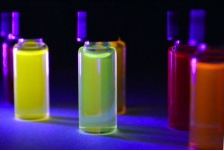
CdTe Quantum Dots, powder, hydrophilic (510 ± 5 nm to 600 ± 5 nm)
View Product
Zn-Cu-In-S/ZnS Quantum Dots, cadmium free, hydrophobic (530-5mg-700-25mg)
View ProductReady to Advance Your Solar Research?
The future of energy is being built at the nanoscale. Whether you're developing next-generation solar cells or exploring novel light-harvesting systems, the right materials are critical.
Browse Our Quantum DotsHave Questions or a Custom Requirement?
Our team of experts is ready to assist you. Contact us for technical queries, bulk orders, or custom material synthesis.