Introduction: The Dawn of a New Materials Era in India
In the landscape of advanced materials, a quiet revolution is underway, driven by the immense potential of nanotechnology. For a nation like India, with its ambitious goals in manufacturing, defense, and space exploration, the development of next-generation materials is not just an academic pursuit—it's a strategic imperative. Among the most promising candidates in this field are **nano borides**, a class of materials renowned for their extreme hardness, high melting points, and exceptional chemical stability.
Traditionally, the **synthesis of borides** has been a challenging endeavor, often requiring extreme temperatures and complex vacuum systems, making it energy-intensive and difficult to scale. However, a powerful technique known as **high-energy ball milling (HEBM)** has emerged as a game-changer. This method offers a pathway to produce **nanostructured borides** at room temperature, making the process more economical, scalable, and environmentally friendly.
This article delves into the world of **nanotechnology in borides**, providing a comprehensive overview for Indian researchers, engineers, and industries. We will explore the fundamentals of nano borides, the significant benefits of using HEBM for their synthesis, and the detailed **nano borides ball milling synthesis procedure**. Furthermore, we will highlight their key applications and the burgeoning opportunities they present within the Indian R&D and industrial ecosystem.
Why Should Indian Researchers Focus on HEBM for Boride Synthesis?
For the Indian research community, adopting high-energy ball milling for **boride synthesis** offers a multitude of advantages that align with national priorities of innovation and self-reliance:
- Cost-Effectiveness: HEBM operates at ambient temperatures, drastically reducing the energy consumption and infrastructure costs associated with high-temperature furnaces.
- Scalability for Industrial Use: The process is directly scalable from laboratory grams to industrial kilograms, bridging the often-difficult gap between research and commercial production.
- Enhanced Material Properties: The technique produces **nanostructured borides** with ultra-fine grains, leading to superior hardness, toughness, and reactivity—properties highly sought after in advanced applications.
- Access to Novel Materials: HEBM can be used to synthesize metastable phases and composite materials that are impossible to create using traditional equilibrium methods, opening new frontiers in material science.
- Simplicity and Versatility: The experimental setup is relatively simple, allowing for rapid prototyping and testing of various material compositions, accelerating the pace of innovation.
Key Industrial Applications of Nano Boride Materials
Aerospace & Defense
The exceptional strength-to-weight ratio and high-temperature stability of materials like Titanium Diboride (TiB₂) and Zirconium Diboride (ZrB₂) make them ideal for components in hypersonic vehicles, rocket nozzles, and lightweight, high-performance armor systems for personnel and vehicles.
Cutting Tools & Abrasives
As some of the hardest materials known, nano borides are used to create superhard coatings for industrial cutting tools, drills, and grinding wheels. This significantly enhances tool life, reduces friction, and allows for higher precision machining of hard metals and composites.
High-Temperature Refractories
The chemical inertness and extremely high melting points of nano borides make them perfect for manufacturing crucibles to handle molten metals, electrodes for aluminum smelting, and protective linings for industrial furnaces, ensuring longevity and purity in metallurgical processes.
Nuclear Engineering
Boron has a high neutron absorption cross-section. This property is harnessed in **boride materials** like Hafnium Diboride (HfB₂) for use in control rods and shielding in nuclear reactors, contributing to the safety and efficiency of nuclear power generation.
The Nano Borides Ball Milling Synthesis Procedure: A Step-by-Step Guide
The synthesis of nano borides via HEBM is a mechanochemical process where high-energy impacts from grinding balls induce chemical reactions in a powder mixture. Here’s a detailed breakdown of the procedure:
Step 1: Precursor Selection and Stoichiometry
The process begins with selecting high-purity elemental powders. For instance, to synthesize Titanium Diboride (TiB₂), one would use titanium (Ti) and amorphous boron (B) powders. The powders are weighed precisely in the correct stoichiometric ratio (1 mole of Ti to 2 moles of B). The purity and initial particle size of these precursors are critical for the final product's quality.
Step 2: Preparing the Mill
The powder mixture is loaded into a hardened steel or tungsten carbide vial along with grinding balls of the same material. The vial is then sealed, typically inside a glovebox under an inert argon atmosphere, to prevent oxidation of the reactive metal powders during milling. This is crucial for achieving high-purity **boride materials**.
Step 3: Setting Milling Parameters
This is the most critical stage, where key parameters determine the outcome:
- Ball-to-Powder Ratio (BPR): A higher BPR (e.g., 15:1 or 20:1) imparts more energy, accelerating the reaction.
- Milling Speed: Measured in RPM, higher speeds increase the impact energy but can also lead to excessive heat.
- Process Control Agent (PCA): A small amount (1-2% by weight) of a substance like stearic acid or toluene is often added to prevent excessive cold welding of the powder particles and to control the **chemical behavior of borides** during formation.
Step 4: The Milling Process
The sealed vial is placed in a high-energy planetary or attritor ball mill. During milling, the powder particles are repeatedly flattened, fractured, and welded together. This intense mechanical energy breaks chemical bonds and creates highly reactive surfaces, eventually triggering a solid-state combustion reaction that forms the desired boride phase.
Step 5: Post-Milling Analysis and Treatment
After milling for a predetermined time (from a few hours to over 40 hours), the resulting powder is analyzed using techniques like X-ray Diffraction (XRD) to confirm the formation of the boride phase and estimate crystallite size. Electron microscopy (SEM/TEM) is used to observe the nanostructure. In some cases, a low-temperature annealing step may be required to improve crystallinity and relieve internal stresses.
Opportunities for Nanotechnology in Borides within India
The push for **nanotechnology in borides** aligns seamlessly with India's national missions like 'Make in India' and 'Aatmanirbhar Bharat' (Self-Reliant India). Domestic production of strategic materials like **nanostructured borides** can significantly reduce import dependency, especially in the defense and aerospace sectors. Research institutions like the IITs, IISc, and CSIR labs are at the forefront of materials science research, and there is a growing ecosystem for industry-academia collaboration.
The government's focus on creating manufacturing hubs and promoting R&D provides a fertile ground for setting up facilities for the **synthesis of borides** using scalable technologies like HEBM. This presents a massive opportunity for Indian scientists and entrepreneurs to lead in the field of advanced ceramic materials, catering not only to domestic demand but also to global markets.
Recommended Nano Boride Products

Titanium Boride Nanopowder (3-8 microns)
View Product →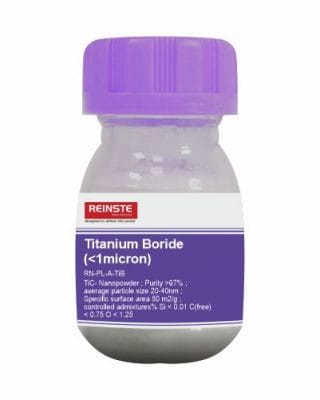
Titanium Boride (<1 micron)
View Product →
Zirconium Diboride Nanopowder (ZrB2)
View Product →Frequently Asked Questions (FAQ)
Nano borides are ceramic materials composed of boron and a more electropositive element, where the particle or grain size is in the nanometer range (typically 1-100 nm). This small size gives them exceptionally high hardness, superior wear resistance, high melting points, and unique electrical properties compared to their bulk counterparts.
HEBM is a top-down mechanochemical process that allows for the synthesis of nano borides at or near room temperature. It avoids the high temperatures required by conventional methods, reducing energy costs and preventing grain growth. This makes it a scalable, cost-effective, and efficient method for producing large quantities of high-purity nanostructured borides.
Their exceptional properties make them suitable for demanding applications, including: superhard coatings for cutting tools, wear-resistant parts, armor plating for defense, refractory crucibles for molten metals, and neutron-absorbing materials in nuclear reactors.
Yes, high-energy ball milling is highly scalable. The principles can be applied to industrial-scale mills capable of producing kilograms of material per batch. This scalability is crucial for meeting the demands of India's strategic sectors like aerospace, defense, and manufacturing, aligning perfectly with initiatives like 'Make in India'.
The primary challenges include contamination from the milling media (balls and vial) and the tendency for nanoparticles to agglomerate (stick together). These are managed by using hard-coated milling tools, optimizing milling parameters, and employing process control agents (PCAs) to prevent excessive cold welding.
Advance Your Research Today
Ready to pioneer the next generation of advanced materials? Explore our range of high-purity nano boride powders or get in touch with our material science experts.
Contact Us